



About ALS
About ALS
ALS is not simply a condition of motor neuron aging.
Recent neuroscience research suggests that its underlying mechanisms involve abnormal protein accumulation, chronic neuroinflammation, and immune system imbalance.
This page provides an overview of this intractable disease based on the latest scientific insights.
Definition
Definition of Amyotrophic Lateral Sclerosis (ALS)
Amyotrophic Lateral Sclerosis (ALS) is a progressive neurodegenerative disease that selectively affects motor neurons in the brain and spinal cord, leading to muscle wasting and weakness throughout the body. Since its first description by Jean-Martin Charcot in 1869, ALS has remained one of the greatest challenges in neurology.
In Japan, ALS is recognized as a designated intractable disease by the Ministry of Health, Labour and Welfare, with approximately 10,000 patients. The peak age of onset is in the 60s to 70s, but onset in the 40s and 50s is not uncommon. A key feature of ALS is that while motor neurons are affected, eye movements, sphincter control (urination and defecation), sensory nerves (five senses), and cognitive functions are relatively preserved until the late stages. The cruel reality of "maintaining clear consciousness in a body that can no longer move" represents the greatest suffering for ALS patients and their families, and it is the core challenge we must overcome.
Molecular Mechanism
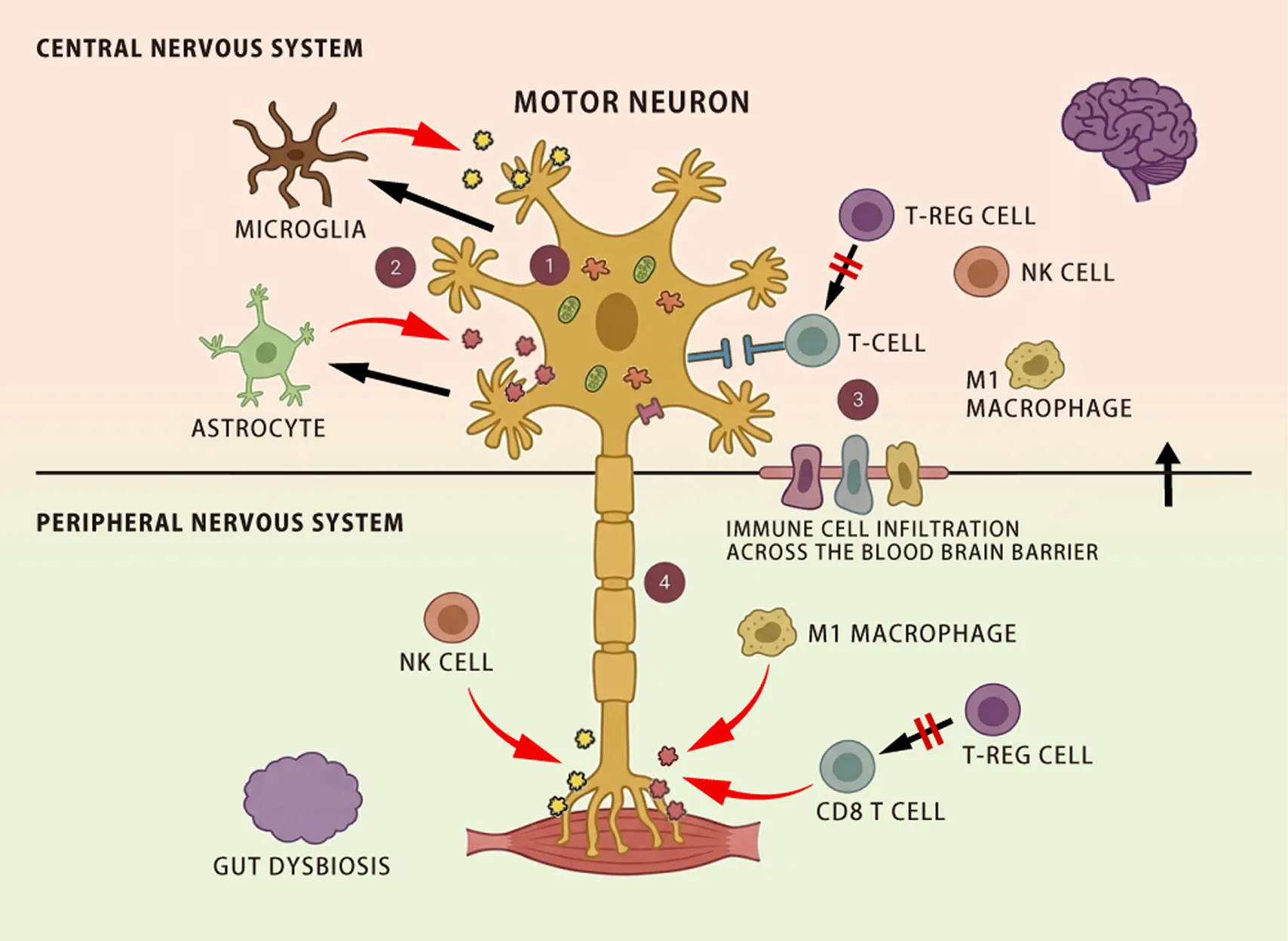
Molecular Mechanisms of Neuroinflammation: Abnormal Accumulation of TDP-43
"A major breakthrough in understanding the pathophysiology of ALS in the 21st century has been the identification of the abnormal accumulation of a protein known as TDP-43. Under normal conditions, TDP-43 plays a central role in RNA metabolism within the cell nucleus. However, under conditions of cellular stress or due to genetic factors, TDP-43 can mislocalize to the cytoplasm, where it forms pathological aggregates. These aggregates are not only toxic to motor neurons, but also result in the loss of essential protein supply, ultimately driving neuronal cells toward degeneration and death."
However, the loss of motor neurons alone cannot fully explain the rapid and relentless progression of the disease. As a result, neuroinflammation has emerged as a key area of interest. When microglia and astrocytes—the brain’s resident immune cells—sense dying neurons or abnormal protein aggregates, they transition from their normal protective state to an aggressive, pro-inflammatory phenotype. The excessive inflammatory cytokines they release, including TNF-α and IL-1β, trigger a process akin to a biological “wildfire,” in which inflammatory damage spreads to neighboring motor neurons that were previously healthy, leading to their progressive degeneration and death.

Evidence
The Immune System's Brakes: Tregs and the Scientific Evidence
Regulatory T cells (Tregs) function as the immune system’s natural brake, helping to regulate excessive inflammation. In ALS, numerous international clinical studies have shown that this key regulatory mechanism is impaired, both quantitatively and functionally.
Scientific Evidence: Key Publications

01Correlation between Treg levels and disease progression (David R Beers et al., 2017, JCI Insight)
In a study led by Professor Appel and colleagues at Houston Methodist Hospital, the number and suppressive function of regulatory T cells (Tregs) in the blood of ALS patients were evaluated. The results demonstrated a statistically significant negative correlation between Treg quantity and function and the rate of disease progression. These findings provide some of the strongest scientific evidence supporting Treg supplementation as a therapeutic strategy for ALS.

02Safety and Efficacy of Autologous Treg Transplantation(Thonhoff et al., 2018, Neurology)
In a Phase I clinical trial, regulatory T cells (Tregs) were collected from the patient’s peripheral blood, expanded ex vivo, and administered via intravenous infusion. No disease progression was observed during the treatment period, demonstrating the safety of autologous transplantation as well as its clinical relevance.

03L-2–mediated activation of Tregs (including the MIROCALS trial)
Low-dose interleukin-2 (IL-2) administration selectively expands regulatory T cells (Tregs) in vivo and may help reduce neuroinflammation. Multiple clinical trials are currently underway to evaluate this potential therapeutic effect. In combination with autologous Treg transplantation, this approach is expected to help maintain a stronger immunological “braking” function.
Q&A
Specialist Q&A: Current Status of ALS Diagnosis and Treatment
QIs there a single test that can definitively confirm a diagnosis of ALS?
Unfortunately, at present, there is no biomarker or single test that can definitively establish a diagnosis of ALS on its own.
The diagnosis of ALS is based on a comprehensive assessment that includes clinical findings indicative of upper and lower motor neuron dysfunction, confirmation through neurophysiological testing using needle electrodes, and the exclusion of other conditions with similar clinical features, such as multiple system atrophy, cervical spondylosis, and inclusion body myositis. Early diagnosis requires a thorough and precise evaluation by a neurologist.
QHow do riluzole and edaravone differ?
Conventional medications primarily target glutamate-mediated neurotoxicity and oxidative stress caused by reactive oxygen species.
In contrast, the Treg therapy we propose aims to suppress chronic neuroinflammation itself—the key driver of disease progression—by restoring the immune system’s regulatory “brakes.” Its fundamental distinction from conventional symptomatic approaches lies in its objective of modulating the underlying immune environment.
QHow common is hereditary ALS?
In Japan, approximately 90–95% of ALS cases are classified as sporadic, with no clear family history.
The remaining 5–10% of cases are familial (hereditary), in which gene mutations such as SOD1, C9orf72, TARDBP (TDP-43), and FUS have been identified as contributing factors. Even in sporadic cases, there are shared pathological features at the molecular level, including TDP-43 proteinopathy and neuroinflammation. Treg therapy is designed to target these common underlying disease mechanisms.
ALS as a “Controllable Disease”
ALS has long been regarded as a condition with limited treatment options, in which the primary challenge has been slowing disease progression. However, we are now entering a new era in which a range of promising therapeutic approaches—such as drug discovery using iPS cells, antisense oligonucleotide (nucleic acid)-based therapies, and Treg-based immunotherapy, a form of cellular immunotherapy that our clinic is pioneering—are beginning to emerge in clinical practice.
It is important to identify therapeutic opportunities at an early stage, before neuroinflammation progresses and its impact on motor neurons becomes more pronounced. Early detection, together with scientifically grounded and appropriate treatment, is key to improving the prognosis of ALS and opening new possibilities for the future. We are firmly committed to this approach and believe it can help reshape what is possible for patients.

What is Treg Therapy?TREG THERAPY
Mechanisms of Neuroimmune Modulation Using the World’s First Triple Combination Approach.

Clinical Support MEDICAL SUPPORT
Upon request, we provide comprehensive assistance covering administrative procedures and daily life support, ensuring seamless, end-to-end care.

